re.creation
A body of work

On November 10, I’ll sing my third and final doctoral recital, and I’m once again taking a degree requirement as the opportunity to workshop a program I intend to use again. This time, it’s one that’s been cooking for over a year and a half: a piece about embodied interpretation as an act of co-creation became an exploration of the ongoing act of self creation, performance, and re-creation when cancer care took over much of my life for the better part of a year. What follows is my program note for the performance.
In the opening piece of Gabriel Fauré’s La Chanson d’Ève, God gives Eve a task: “Go, human daughter, / And give to all the beings / I’ve created, a word from your lips, / A sound by which to know them.” This directive echoes the foundational Judeo-Christian creation myth: “Then God said, ‘Let there be light’; and there was light” (Genesis 1:3); “In the beginning was the Word, and the Word was with God, and the Word was God” (John 1:1). That is, the act of speaking is entwined with the act of creating, voice and generative power indelibly linked. Here, Eve is the one given the breath of life to speak, and specifically to name or, effectively, to interpret God’s world to bring it into its fullest existence. There’s no snake, no forbidden fruit, no Adam. She doesn’t have to pluck knowledge and be punished for it. God turns Eve into a co-creator through her voice.
We typically see Eve as an originator by virtue of her reproductive abilities; here she’s a creator through intellectual and artistic action. However, that divine action still comes from her body and from her sensory connection to the natural world around her. At the end of the song, “[Eve’s] voice is quiet, but everything still listens for it, Everything awaits; / When as the evening star rises, / Eve sings.” God utters the first words of the cycle, but eight of the nine songs that follow are in Eve’s first-person. In just a few stanzas, the narrative power shifts. In carrying out her task, Eve herself becomes a god.
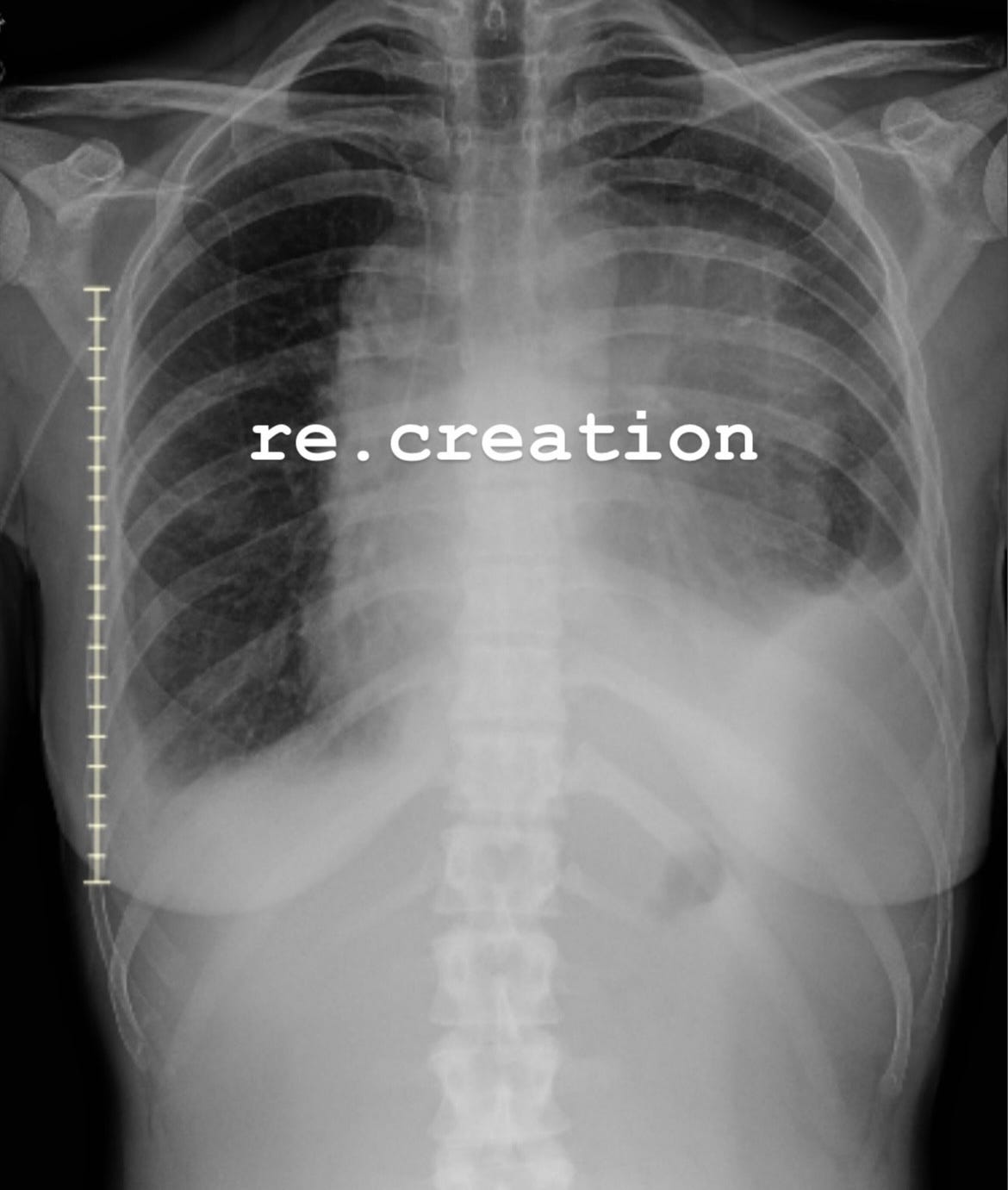
This possibility immediately and massively struck me as someone who uses her voice to interpret the works of others – composers who in the first years of my training were exclusively men. Increasingly, I find that the acts of interpreting, creating, writing, reading, performing, and listening are interconnected and blurred, and this has become a major theme in what I write, what I choose to sing, and how I approach my relationship to performance. In the summer of 2024, I began developing a concert-length piece centered around the Fauré cycle that would mix musical performance, analysis, and lived experience to explore what the act of creation can mean in its various facets. As I wrote my sensations and ideas about Eve, nature, and generation in my journals, I was also unknowingly documenting the symptoms of a rare blood cancer. By September, a large and rapidly growing tumor in my chest was encroaching on my heart and lungs. Because I was working on La chanson d’Ève in a residency and rehearsing it for an upcoming concert, its phrases became the daily testing ground for my deteriorating breath capacity. At the end of the month, I was hospitalized with chest pains, difficulty breathing, and a newly discovered mass. Two weeks later, the aggressive chemotherapy course I had begun in hospital was already impacting my tumor, and I calculated my improving breath through the same Fauré phrases. Eve remained my companion, and my interest in the creative body took on new, existential dimensions.
Patients are encouraged to find creative outlets during cancer treatment. We’re told to write, to speak, to create in order to process. Crafting is intrinsically linked to performance for me, and as I mature as an artist, I’m more invested in the process of making music, of doing/making (faire) as an act from and of the body. My diagnosis meant the threat of losing my ability to create. When I was first hospitalized, I had to slash the artistic season that was just starting, at first partially, then entirely. If my first concern upon learning that I had a large tumor in my chest was for my life, my second fear, immediately, was that I would no longer sing, in the uncertain period of “during” and perhaps never again after. I did sing in my “during.” I practiced in the hospital hooked up to chemo. I practiced sitting down when I didn’t have the strength to stand. I practiced during the long winter and spring of second- and third-line therapy when my cancer didn’t fully respond to chemotherapy. I practiced during radiotherapy in summer.
I sang for upkeep, for my “after.” It was a decidedly faithful act from someone who’s always been staunchly unreligious, faithful in the sense of being loyal to a practice, and in the sense of having faith that I would be able to sing in public again. I was regularly – let’s not pretend it was daily – returning to my body, myself, and my means of creating. I was also returning to myself in writing: pages and pages of journal entries, about the changes to my body and about the act of writing the body. And I was, in those journal pages, hashing out my thoughts for my dissertation on embodiment and the performer’s body, the type of material creation that comes from the body and its processes. It all seemed to me to be one ongoing action of consideration, practice, analysis. I contemplated my body as the vector for myself, my body as the thing of interest, and my voice – literal and figurative – as the means of understanding, processing, and sharing. My new artistic and intellectual project became the intersection of my flesh and experience with the gigantic daily care of cancer.
In that way it was not so different from when I take on a piece of music. As a singer, I must attend to daily practical and physical demands while slotting myself into a work’s cultural imprint and legacy. When I sing, I have to contend with the overlap and distance between me and the work, how my voice does and does not belong to the piece, how the piece does and does not belong to my voice. How my physical performance – my physical reality – incarnates and so creates the piece, and how the piece shapes my voice. Similarly, my cancer is uniquely my own while also part of the complex etiological, pathological, and cultural entity that is cancer.
I immediately began to call cancer my new 2024-25 season project as chemo cycles and hospital stays replaced performances on my calendar. But I was adamant that the project of my cancer would be more than appointments, managing side effects, and surviving. This meant that living my cancer would be writing and performing it: an ongoing enterprise of creating and recreating myself as a body and interpreter.
La Chanson d’Ève was composed between 1906 and 1910, during Fauré’s late creative period, in which his compositional style had become increasingly refined, introspective, and harmonically daring. The song cycle sets ten poems by Charles van Lerberghe, drawn from his symbolist collection La Chanson d’Ève (1904), which explores the awakening of consciousness, nature, and spirituality through the figure of Eve. Coupled with the ethereal, pantheistic imagery of the poetry, Fauré’s music creates a crystalline, sometimes ebullient, and suspended world of wonder.
The cycle opens with the first morning of the world, everything still blurry and indistinct. The second song begins Eve’s first-person narrative. Its title, “Prima verba” (first words) conjures up primavera (spring), but while it depicts new life, the song is calm, serene, pensive. This isn’t timidity on Eve’s part as she embarks on her awesome task; rather, it’s the comfort of discovering while already belonging: “The long-murmuring soul of the fountains and woods sings in my voice… Words asleep for ages finally come to life on my lips.” This paradoxical circumstance sums up the creativity of interpretation. The world predated Eve – it lay dormant and expectant – but needed her to come into its new self. It was both pre-existing – already existing – and pre // existing – it had not yet come into its existence. Eve responds to the world, and in her response, even in her very presence, she’s the one to create it.
The first day comes into being “like an abashed flower exhaled by the night.” Because breath is the basis of sound both spoken and sung, it’s the basis of Eve’s act of creation and communication with the world around her. Her body exhales sound and scent, and the plants respond with their own perfume. The Latin spirare (to breathe) is the root of the French respirer, aspirer, inspirer, expirer, and the English aspire, inspire, expire. One definition of “inspiration” is to receive divine guidance; another is to receive breath. The breath of life is the breath of creation. The fact that we’re alive means that we’re able to create in turn.
Aspirer – or aspire – also means to reach, to yearn. The plants lap up divine water (“Eau vivante”), but they also aspire to God. Eve, in the process of being and making, constantly reaches back to God, “towards the primeval ocean.” This originating point isn’t a final place of return, however, but rather part of a cycle of flow: “You who come and go, ceaselessly.” Similarly, the death to which Eve sings, “It’s in you that I want to spread, to burn out and dissolve” is a stardust that makes up the matter of the universe (“Ô mort, poussière d’étoiles”).
Eve uses the verb aspirer as she addresses death: Mort, où mon âme aspire! This can mean, “Death, to which my soul aspires,” but I can also translate it as, “Death, where my soul inhales.” They come to mean the same thing, reaching out and reaching inward. All the reaching and listening and breathing that went into creating the world and life itself now serves death, another transmutation in the cycle. Eve dissolves into the work she helped create, into the night that exhales the next first morning of the world.
Fauré’s cycle takes Eve from morning into night, but I felt that a program that chronicles a year of sickness, treatment, and waiting should spend longer in the darkness. Night conjures up exposed uncertainty and fear, but its strangeness and solitude can also lead to wonder.
“Nacht” (“Night”) is the first song of Alban Berg’s Sieben frühe Lieder (Seven Early Songs), composed between 1905 and 1908, when Berg was studying with Arnold Schoenberg in Vienna. The poem, by Carl Hauptmann, evokes an unfamiliar nocturnal landscape where darkness absorbs nature and human consciousness, exploring the dissolution of boundaries between self and nature, light and shadow, consciousness and dream. The song ends with an imperative: O gib acht! gib acht. This can be translated as a warning – be careful – but it can also be the instruction to pay attention to the marvels that night brings.
Betsy Jolas was “fascinated by the strange beauty” of the Victor Hugo pieces collected by the poet André du Bouchet (at one time, her brother-in-law) in L’œil égaré dans les plis de l’obéissance au vent. She set these three times: in 1961 as a radio cantata for choir, soloists, and orchestra; in 2002 as a six-song cycle for baritone and piano; and in 2004 as two songs for solo voice available in French or in an English translation by Jolas herself. De nuit (By night) explores the vastness and mystery of night, as well as multiple planes of solitude and imagination through an exposed a capella setting and use of different vocal textures including speech, humming, and microtonality. The singer is left alone to create a world with the spare structure of the work’s words, a single line of pitches, and the space around them. “Where does all this lead? I do not know. And night makes a rutted way for stars.”
There’s always an element of solitude to illness. I’ve had the privilege of an incredible community watching me and bolstering me throughout my cancer, but isolation has nonetheless been unavoidable. It’s been maddening, terrifying, clarifying, repulsive, and required. And, over and over, I’ve found the same self in the spiral inward of my illness, calqued onto a more extreme situation. Once I largely stopped fearing I would die, I started fearing I would cease to exist. To put it simply, I became a performer because I feed on attention. But there’s also a necessary element of solitary work in my musical practice and writing, and the more I mature, the more I realize that whatever comfort and conviction I’m able to nurture in isolation serves me in front of an audience. It defines me – or rather, it allows me to define myself and better understand others’ reflection of me.
My community has allowed me to continue to perform myself in the absence of performing music, and now it allows me to perform music about myself. My friends and collaborators Betsy Podsiadlo, Yoshi Weinberg, and Jonathan Howard Katz have each written a piece with texts from my journals, giving me the opportunity to perform my cancer in a new way. Like the progression of morning to night in La Chanson d’Ève and the additional night music I’ve chosen by Berg and Jolas, all three entries revolve around moments of the day: high noon, midnight, and morning. Perhaps it’s only logical to situate a changing body within the architecture of hours.
I wrote the text of 27 July 2024 (set by Betsy Podsiadlo) in a sunny meadow in Summit, New York, during a short residency working on my Eve project. I sang and wrote outside surrounded by clover, wild thyme, and bees, analyzing the multisensory melding in van Lerberghe’s poetry and trying to memorize the experiences of my body thinking and making music. Those experiences included my increasingly tender and brittle ribcage, the reality of my breathing body necessarily seeping into my work. I tried to process the disturbing uncaniness of my condition through nature encircling me. “My sternum is a large black beetle. His legs are stuck.”
La Fille humaine (“The Human Daughter,” Yoshi Weinberg), whose title comes from God’s command to Eve in the first Fauré song (Va, fille humaine), is brimming with the novel surrealness of diagnosis and treatment. I wrote this journal entry the day after I was released from my first hospitalization. I had just publicly announced my cancer. During the night, I had woken up still thinking I was in my hospital room. After five days of continuous chemotherapy day and night, I couldn’t understand why the ever-present line connecting my arm to my infusion was absent. In the morning, I wrote: “My sickness is more real. It has finally completely come into the enclave of my normalcy. Because I returned to my normalcy abnormal. I feel my alien aspect more.” Cancer means navigating innumerable, blurry lines of “before” and “after.” The fixed track in Yoshi’s setting is composed of recordings I made in late August 2024 singing the highly contrapuntal piano lines in two of the Fauré pieces. That voice was produced by a chest riddled with cancer. Now, I am literally accompanied by my “before” in my “after.”
“After” is also the focal theme of the entry of 12 December 2024 (Jonathan Howard Katz). After each cycle of chemo, I noted the ever-changing side effects, trying to map out a pattern to make sense of how my body felt in the moment and how it might feel in the future. I also tracked my changing appearance – temporary changes such as my face puffed by steroids, my bald body, my soft skin, and the changes that would follow me longer, such as the constellation of small scars accumulating on my upper arms and torso. I wondered: “When will the insideness of them disappear? Will it?”
Thank you to all who have accompanied me in my process[ing] and continue to do so.
What a profound read. Thanks again Sophie. Whether it’s your YT channel, or your writing here, I always find myself taking something away to tuck in to my metaphorical pocket. As someone living with a lifelong disability, I have a sometimes strange relationship with my own body, as well as what can appear to define me… confine me… It’s complex, frustrating at times… but I also feel that it brings something unique… In any case, congratulations on what you have created in moving through your “season project”. I’m so happy for you. So proud of you. Always wishing you well, and more power to your arm. JB.
The upcoming recital sounds like a huge milestone, Sophie. I’ve so appreciated your reflections on this type of cancer that we share. Although our experiences have differed, they overlapped and I felt a kinship with you.